
A Coursera Plus subscription gives you one login for more than 10,000 courses, Specializations and Professional Certificates. The hard part is not deciding whether you want it. It is choosing between the monthly plan and the annual plan without wasting money.
This guide does that maths for you. We checked Coursera’s own page and India pricing reports on 11 November 2026, worked out the month where annual becomes cheaper, and explained the trial, refund and certificate rules that most people only discover after paying.
Quick answer
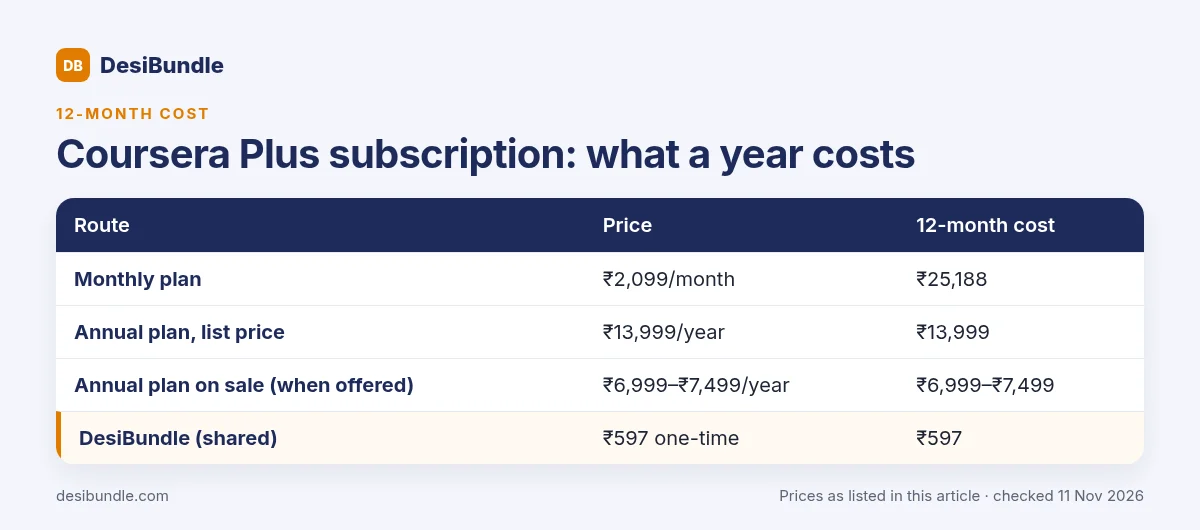
- In India the Coursera Plus subscription is ₹2,099 a month or ₹13,999 a year at list price.
- Annual becomes cheaper than monthly once you study for 7 months or more. During a sale it pays off after about 4 months.
- Monthly has a 7-day free trial. Annual has a 14-day refund window, but certificates earned in those 14 days are revoked if you take the refund.
- For practice without certificates in your name, DesiBundle’s shared plan is ₹597 one-time for a year.
Coursera Plus subscription price in India (2026)
Coursera charges Indian learners in rupees. These are the prices we could confirm for a Coursera Plus subscription.
| Plan | Price in India | What it means |
|---|---|---|
| Coursera Plus Monthly | ₹2,099 a month | Cancel any time, 7-day free trial for new subscribers |
| Coursera Plus Annual (list) | ₹13,999 a year | Paid upfront, about ₹1,167 a month |
| Coursera Plus Annual (sale) | ₹7,499 (Aug–Sep 2026 sale); ₹6,999 half-price offer reported 5 Nov 2026 | Only during promotions, new subscribers |
| Single course or Specialization | From ₹1,699 a month | Pay for one programme only |
| DesiBundle shared access | ₹597 one-time | Shared account, 1 year, no renewal |
Sources: The Indian Express reported Coursera’s localised India pricing of ₹2,099 a month and ₹13,999 a year for Coursera Plus, and ₹1,699 a month for single programmes. The official Coursera Plus page says local currency and pricing are shown at checkout outside the US. On 11 November 2026 it showed US visitors $239 a year, cut from $399, so a sale was running. Check your own checkout for the live rupee price.
Monthly vs annual Coursera Plus subscription: the break-even maths
Here is the simple maths behind the choice. Divide the annual price by the monthly price and you get the month where annual starts saving money.
| Annual price you see | ÷ ₹2,099 monthly | Annual is cheaper if you study for… |
|---|---|---|
| ₹13,999 (list) | 6.7 months | 7 months or more |
| ₹7,499 (sale) | 3.6 months | 4 months or more |
| ₹6,999 (half-price offer) | 3.3 months | 4 months or more |
So the honest answer depends on one question: how long will you really keep studying? Most people overestimate this. If you have finished online courses before, you know your pace. If you have not, start monthly.
Choose the monthly plan if…
- You want one Professional Certificate and can finish it in 2 to 5 months
- You have never stuck with an online course before
- You want the 7-day free trial first
- Your budget is monthly, not one lump sum
Choose the annual plan if…
- You plan two or more certificates back to back
- A sale price is running (₹6,999–₹7,499)
- You learn steadily all year, for example alongside a job
- You are happy to pay upfront for the lowest per-month cost
What a Coursera Plus subscription includes (and excludes)
Coursera says a Coursera Plus subscription gives “unlimited access to more than 10,000 courses, Projects, Specializations, and Professional Certificate programs”. That covers most of the catalogue, including popular programmes from Google, IBM, Meta, Microsoft and universities like Duke and Michigan.
Included
- 10,000+ courses and Guided Projects
- Specializations and Professional Certificates (look for the Coursera Plus badge)
- Unlimited certificates once the trial ends
- Hands-on labs and projects on many courses
Not included
- Online degrees
- MasterTrack certificates
- Certain courses, Specializations and certificates that are excluded
- Your other Specialization subscriptions, which keep billing until you cancel them
That last point catches people out. Coursera’s FAQ says existing Specialization subscriptions “won’t automatically cancel” when you start Coursera Plus, so cancel them yourself or you pay twice.
Coursera Plus free trial and refund rules
The trial and refund rules are different for each plan, so read this before you pick one.
Monthly: 7-day free trial
Coursera takes your payment details when you subscribe, but does not charge you until the 7-day trial ends. Cancel during the trial and you pay nothing. You cannot earn certificates during the trial, though.
Annual: 14-day refund window
There is no free trial on the annual plan. Instead you have up to 14 days to ask for a refund from your My Purchases page, with no reason needed. Coursera warns that “any certificates that you earn within your first 14 days will be revoked” if you take the refund.
How to get a Coursera Plus subscription cheaper
You rarely need to pay the full price for a Coursera Plus subscription. These are the legitimate ways to pay less, in order.
- Wait for a sale. Coursera runs annual-plan sales several times a year. In 2026 we saw ₹7,499 in August–September and a reported ₹6,999 half-price offer in November.
- Ask your employer or college. Many organisations use Coursera for Teams or Coursera for Campus, which covers everything in Coursera Plus for free to you.
- Apply for Financial Aid on one course. Coursera offers financial aid on many individual courses. It does not apply to the Coursera Plus subscription itself, but it can make one certificate free.
- Finish fast on monthly. One focused Professional Certificate in 2 to 3 months costs ₹4,198 to ₹6,297, often less than the annual list price.
- Use a shared plan for practice. If you only need to learn the material, a shared account is the cheapest route.
Coursera shared access: ₹597 for 1 year
- One-time UPI payment, no auto-debit
- Web access on PC/Mac
- Shared account, certificates are not issued in your name
See the Coursera shared plan →
Shared/group-buy access. Not affiliated with the brand. Limits apply; see the product page and refund policy.
Coursera Plus subscription vs a shared plan
A shared plan costs a fraction of any official Coursera Plus subscription, but you give up some things. Here is a fair comparison.
| Official Coursera Plus | DesiBundle shared | |
|---|---|---|
| Price | ₹2,099/month or ₹13,999/year | ₹597 one-time, 1 year |
| Account | Your own, private | Shared login |
| Certificates | In your name, shareable on LinkedIn | Issued to the account owner, not you |
| Progress and grades | Private to you | Visible to other users |
| Devices | Web and mobile apps | Web on PC/Mac |
| Renewal | Auto-renews until cancelled | Never renews |
| Payment | Card or local methods at checkout | UPI |
Our advice is simple. If the certificate in your name is the goal, pay for the official plan. If you want to learn Python, data analysis or marketing for your own work, the shared plan does the job for much less. Read our Coursera group buy India page for how ordering works.
Is a Coursera Plus subscription worth it in India?
For most serious learners, yes. Compare the annual list price of ₹13,999 with one Professional Certificate bought on its own at ₹1,699 a month. If you take 5 or more months, or want more than one certificate, Coursera Plus usually wins.
It is less worth it if you only want short, practical skills courses. LinkedIn Learning or Udemy may suit you better. See our LinkedIn Learning price in India guide, the Udemy vs Coursera comparison and LinkedIn Learning vs Coursera to compare.
For the full rupee price breakdown of every Coursera plan, read our Coursera Plus price in India guide. This page focuses on choosing between the monthly and annual Coursera Plus subscription.
Best certificates to take with a Coursera Plus subscription
The Coursera Plus subscription pays off fastest when you take a full Professional Certificate. These are the programmes Indian learners most often pick, and all of them carried the Coursera Plus badge when we checked.
| Certificate | From | Good for |
|---|---|---|
| Google Data Analytics | First job in data, Excel, SQL, Tableau, R | |
| Google Project Management | Project coordinator and PMO roles | |
| Google UX Design | Design portfolios with Figma | |
| IBM Data Science | IBM | Python, SQL and machine learning basics |
| Meta Front-End Developer | Meta | HTML, CSS, JavaScript and React |
| Microsoft Power BI Data Analyst | Microsoft | Dashboards and business reporting |
| Google IT Support | Help-desk and IT support roles |
Coursera lists most of these at a few months of study at around 10 hours a week. That is why the plan choice matters. One certificate at a steady pace fits the monthly plan. Two certificates in a row is where the annual Coursera Plus subscription saves real money.
Plan your first 90 days
Pick one certificate, block fixed study hours in your calendar and set a target finish date before you pay. Learners who do this tend to finish. Learners who sign up “to explore” often pay for months they never use.
Coursera Plus subscription for students and working professionals
Students
Ask your college first. Many Indian colleges and universities have Coursera for Campus, which gives students free access to a large part of the catalogue with certificates in their own name. If yours does not, the monthly Coursera Plus subscription with a single focused certificate is usually the best value. Financial Aid on individual courses is another option for students on a tight budget.
Working professionals
Check whether your employer uses Coursera for Teams or Coursera for Business. Coursera’s page says Teams plans cover “everything included in Coursera Plus” for up to 125 employees, billed per user for 12 months. If your company has one, you get the full catalogue for free. If not, the annual plan during a sale is the cheapest official option for steady learners.
Freelancers and creators
If you want to learn a tool, not show a certificate, a shared plan is often enough. You can watch lessons, do the practice and apply the skill to client work straight away.
6 common mistakes that waste money on Coursera
We see the same mistakes again and again from Indian learners. Avoid these and you will get far more out of whatever plan you choose.
- Buying annual “to be safe”. If you have not finished an online course before, a year upfront is a big bet. Start monthly and upgrade later.
- Forgetting the trial end date. The 7-day trial turns into a paid month automatically. Set a reminder two days before it ends.
- Paying twice. Old Specialization subscriptions keep billing after you join. Check My Purchases on day one.
- Earning certificates inside the refund window. If you might ask for a refund on the annual plan, do not rush certificates in the first 14 days, because they are revoked.
- Ignoring free access you already have. Employer and campus licences are common. One email to HR or your college can save you the whole fee.
- Picking too many courses at once. Enrolling in five programmes feels productive, but finishing one is what gets you the certificate and the skill.
One more habit helps: review your progress at the end of each month. If you are not at least a third of the way through your certificate, change the plan or the pace before the next charge.
How to cancel a Coursera Plus subscription
Both plans renew automatically. To cancel:
- Sign in on the Coursera website and open My Purchases from your profile menu.
- Find Coursera Plus and choose Cancel subscription.
- Follow the prompts and keep the confirmation email.
- If you are within the annual 14-day window and want your money back, request a refund on the same page.
After you cancel a monthly plan, access continues until the end of the month you paid for. Your progress is saved, so you can resume later.
Our verdict: which Coursera Plus plan to pick
Start with the monthly Coursera Plus subscription and its 7-day trial unless you are sure you will study for seven months or more. Switch to annual when a sale brings it near ₹7,000, because then it pays off in about four months. If you only want to learn and do not need certificates, a shared plan at ₹597 a year saves the most.
Prices and offers change through the year, so check the live checkout price on the day you buy, and compare it with the break-even table above. If the annual price you see is less than about four times ₹2,099, annual is the better deal for anyone who will study steadily. If it is closer to the ₹13,999 list price, only commit when you are confident you will keep going for at least seven months.
Whichever you pick, decide your first certificate before you pay. A clear goal is what turns a Coursera Plus subscription into real value.
If you are still torn, look at the next seven months of certificates you already have in mind, not at a generic “unlimited courses” promise. A Coursera Plus subscription pays off when those certificates are real deadlines, not a wish list. Re-check the live checkout for the monthly and annual Coursera Plus subscription totals before you start a trial, because a sale price can appear or disappear without a matching change on older blogs.
Frequently asked questions
How much is a Coursera Plus subscription in India?
The list price is ₹2,099 a month or ₹13,999 a year (as reported by The Indian Express). Sales can bring the annual plan to about ₹6,999–₹7,499. Check the live price at checkout.
Is Coursera Plus monthly or annual better?
Annual is cheaper if you study for 7 months or more at list price, or about 4 months during a sale. Otherwise monthly is cheaper and lets you cancel any time.
Does Coursera Plus have a free trial?
Yes, the monthly plan has a 7-day free trial. The annual plan has no trial but has a 14-day refund window instead.
Can I get a refund on Coursera Plus annual?
Yes, within 14 days of payment from your My Purchases page. Certificates earned in those 14 days are revoked if you take the refund.
Does Coursera Plus include degrees?
No. Online degrees and MasterTrack certificates are not included, and some individual courses and certificates are excluded too.
Will I get certificates in my name with a shared plan?
No. On a shared account, certificates are issued to the account owner. Buy an official Coursera Plus subscription if you need certificates in your own name.
Does my old Specialization subscription stop when I join Coursera Plus?
No. Coursera says existing Specialization subscriptions do not cancel automatically, so cancel them yourself to avoid paying twice.
Want Coursera for less this year?
- Coursera shared access ₹597 for 12 months
- UPI checkout, access details sent after payment is confirmed
- No auto-renewal, nothing to cancel
Shared/group-buy access. Not affiliated with the brand. Limits apply; see the product page and refund policy.